Enable seamless AI shopping experiences with VGS
Unlock payments, transparency, and data accessibility in Agentic Commerce
With VGS, merchants and AI companies can:
- Utilize PCI-compliant, secure, and portable VGS Tokens that are built to transmit sensitive data
- Process secure transactions on behalf of customers and/or agents
- Intelligently perform credential sharing between all parties in a transaction

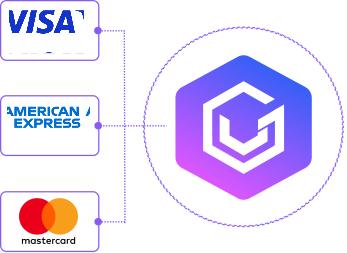
VGS is the only independent vault and enabler to partner with Visa's Intelligent Commerce, Mastercard's Agent Pay, and American Express's ACE programs.

For Merchants
Transparency into Customer Data
- VGS participates throughout the transaction flow, doing so with the agent's permission. You become uniquely positioned to access the contextual information needed to better understand the customer. Whether it's verifying ID, understanding their mandates for agents, or their payment credentials, we have the information you need.
Share Sensitive Data Securely
- Shared data is highly valuable for merchants and is also in the agent's best interest, as it can enhance key areas such as fraud prevention, authorization rates, and customer analytics. By enabling merchants to access this information and optionally share relevant insights with PSPs, VGS can help restore visibility and trust across the payment ecosystem.
Seamless Transactions
- VGS collects the required payment data once from the agent and securely distributes it downstream to any authorized party who needs it. From one-time purchases to recurring transactions, we enable merchants to transact intelligently with the PSP of their choice.
For Agents
Merchant Compatibility and Connectivity
- Initiate and send payments to any merchant, regardless of their payment processing strategy, through VGS's industry leading infrastructure tools. Form secure connections with merchants, agents, and any third-party provider to share credentials and authorize transactions on behalf of customers.
Secure Sensitive Data
- VGS Network Tokens replace sensitive card information with non-sensitive tokens to create a secure environment. Collect, protect, and route those tokens with the PCI-compliant, processor-agnostic VGS Vault for the optimal secure solution.
Seamless Transactions
- Manage subscriptions with users of your AI platform. VGS brings together card updating, higher authorization rates, and powerful fraud reduction tools in one centralized payments solution.

Explore how Agentic Commerce is transforming the commerce landscape
Watch Payments 201, where Travis Mottershead delves into how e-commerce works today, how AI is changing the e-commerce industry, and how AI services enable agentic commerce.
Watch Now
How VGS Closes the Gap for Both Merchants and Agents in Agentic Commerce:
VGS Vault
When tokenizing sensitive data, there needs to be a place to store it. Collect, protect, and store sensitive data with VGS Vault to mitigate risks when your agent needs to use sensitive payment data to route to merchants and agents.


VGS Network Tokens
Agentic commerce operates on network and agentic tokens. Substitute sensitive data with tokens through VGS, a token service provider that is processor-agnostic, allowing you to operate and transact safely while increasing control and transparency over your own data.
PCI Data Compliance
Maintain and build a continuous PCI-compliant environment that protects cardholder data and stores card information on file. When a user returns to make a purchase or an agent-in-the-loop transaction is conducted, the card information and data on file will be ready for a safe and authorized purchase, providing you with insight into the customer.


PII Secure Data Storage
Protect user privacy and comply with data protection regulations to safeguard your business against malicious hacks and prevent damage to your reputation. With VGS, AI agents do not handle sensitive user information; instead, they use a secure token, preventing any sensitive information from being utilized for AI modeling.
VGS Collect
You can create fully customized forms that adhere to PCI, HIPAA, GDPR, CCPA, and 3DS requirements. VGS will intercept sensitive data before it reaches your servers, replacing it with aliased versions while securing the original data in the VGS Vault.

VGS unlocks payments in Agentic Commerce
Whether you're an agent or a merchant, VGS's trusted infrastructure enables seamless buying experiences while staying compliant, helping you scale and grow your revenue.
For AgentsFor Merchants
Ready to close the gap in your infrastructure?
As agentic commerce continues to evolve, transparency and data accessibility are becoming critical to maintaining trust and efficiency across the ecosystem.
Whether you’re a merchant or an AI company, contact VGS to learn how we can assist you
FAQs
Agentic commerce refers to AI agents acting on behalf of an individual (usually a consumer) to make a purchase online. In agentic commerce, agents generally use conversational AI models to help consumers make purchasing decisions and ultimately complete a purchase on their behalf based on a set of consumer-defined parameters. For consumers, agentic commerce aims to enhance the overall buying user experience, similar to a personal assistant, who is authorized to make purchases on behalf of consumers autonomously, enhancing the buying experience by removing purchasing friction. For merchants, agentic commerce has the potential to increase sales and accelerate product discovery & cross-sell opportunities.
You can read more on agentic commerce here.
For Consumers
- Understanding Needs and Preferences: The AI agent on an AI platform (such as ChatGPT or Gemini) learns a user's needs, preferences, budget, past purchase history, and even anticipates future needs based on various data points.
- Intelligent Product Discovery: Instead of a user manually searching on an internet browser (such as Google), the agent autonomously searches across various online marketplaces, evaluates products based on the learned preferences, reads reviews, compares specifications, and identifies the best options.
- Automated Price Negotiation: The agent can monitor prices, identify deals, and even negotiate with sellers to secure the best possible price.
- Autonomous Purchasing: Once the agent identifies the ideal product at the right price, it can complete the transaction autonomously, using the user's preferred payment methods.
- Post-Purchase Management: Some agents can even handle tasks like tracking shipments, managing returns, and seeking refunds if necessary.
For Merchants
- Intelligent Automation: AI agents can automate various backend processes, improving efficiency and reducing manual effort.
- Personalized Recommendations: Agents can analyze customer data to provide highly personalized product recommendations, enhancing the shopping experience and driving sales for the merchant.
- Inventory Management: AI agents can monitor stock levels, predict demand, and automatically manage inventory replenishment for a merchant.
- Customer Interaction: AI-powered chatbots and virtual assistants can handle customer inquiries, provide support, and even guide customers through the purchasing and payment process.
- Dynamic Pricing: Agents can analyze market trends and competitor pricing to dynamically adjust prices for optimal profitability.
- Vendor Onboarding and Management: For marketplaces, AI agents can automate the process of onboarding new vendors, validating product data, and ensuring compliance.
- Order Routing and Fulfillment: Agents can optimize order routing based on factors like inventory, delivery times, and costs, ensuring efficient fulfillment.
- Exception Handling: AI agents can detect and resolve issues such as pricing mismatches or delivery delays, escalating complex cases as necessary.
In traditional e-commerce, the user drives every step: searching for products, comparing options, adding to cart, and checking out. The experience is designed for human clicks, visuals, and manual decisions.
Agentic commerce, on the other hand, flips that model. Instead of users browsing and buying, AI agents handle the process end-to-end by interpreting goals (“find me the best 4K monitor under $400”), comparing prices, verifying quality, and completing transactions within a user's defined rules or budget.
The key difference lies in autonomy and intent:
- Traditional systems assist humans.
- Agentic systems act for humans.
They rely on structured data, APIs, and secure tokenized payment systems that let agents make safe, auditable purchases on behalf of their users.
In short, Traditional e-commerce is manual and human-driven. Agentic commerce is automated and intent-driven, where your AI agent does the shopping, not just the recommending.
In agentic commerce, AI agents are autonomous software entities that proactively manage and execute various aspects of the e-commerce experience, such as researching and making a purchase. Unlike traditional AI tools that require specific prompts or human oversight, these agents can operate with a high degree of independence, making decisions and taking actions to fulfill user needs and business objectives.
Agentic payments area payments initiated and executed autonomously by an AI agent, often without direct human intervention at the point of checkout online. In agentic payments, the agent is authorized to execute the transaction.
An agentic token in payments is a type of digital token that can not only represent value but also carry the ability to act on behalf of the user according to predefined rules or permissions.
Agentic commerce offers a range of benefits for both consumers and businesses by introducing automation, intelligence, and personalization into the buying process. It delivers greater efficiency and time savings by automating repetitive or complex purchasing tasks, minimizing human effort and friction.
With advanced personalization, AI agents learn user preferences, budgets, and priorities to make tailored buying decisions. These agents can also perform intelligent optimizations like tracking promotions, comparing prices, negotiating deals, and automatically reordering when it's cost-effective.
Beyond convenience, agentic commerce ensures consistency and continuity, as agents maintain context over time and act proactively, such as replenishing supplies or managing renewals. For businesses, the model enhances scalability, enabling brands to engage with new agent-driven channels, streamline transactions, and automate post-purchase workflows, all while reducing conversion friction and operational overhead.
To prepare for agentic commerce, businesses need to modernize their digital infrastructure so AI agents can seamlessly interact with their systems. This involves maintaining clean, structured, and machine-readable product data, exposing APIs for inventory, pricing, and order management, and supporting secure, tokenized payments that enable agent-led transactions. Companies should also define clear rules and guardrails for agent behavior, implement monitoring and fallback systems for oversight, and pilot agentic workflows in low-risk categories first. Above all, they must build trust and transparency with users by explaining how agents make decisions and how control can be regained, while staying aligned with emerging agentic commerce protocols and standards.